
Most Sustainable Building Material: Impact on Foodservice

Swapping single-use plastics for biodegradable options has become a pressing concern for many restaurant owners and bar managers who want to lead the way in responsible operations. Sustainable packaging choices now directly affect brand image, customer loyalty, and compliance with new environmental standards in countries around the world. This article uncovers the practical benefits and critical considerations of choosing eco-friendly materials like biodegradable straws, guiding foodservice professionals toward smarter, greener decisions for their businesses.
Table of Contents
- Defining Sustainable Building Materials
- Comparing Leading Eco-Friendly Materials
- Evaluating Durability And Biodegradability
- Certification, Safety, And Supply Chain Standards
- Why Foodservice Industry Choices Matter
Key Takeaways
| Point | Details |
|---|---|
| Sustainable Building Materials | These materials minimize ecological impact while maximizing performance throughout their lifecycle, emphasizing long-term environmental responsibility. |
| Lifecycle Assessment | A critical evaluation framework that tracks materials’ environmental performance from extraction to disposal, aiding informed decision-making in construction. |
| Durability and Biodegradability | Material selection must consider not only immediate performance but also durability and environmental impact over time. |
| Certification Standards | Prioritize sustainable materials with transparent third-party certifications to ensure environmental and safety compliance, driving responsible innovation. |
Defining Sustainable Building Materials
Sustainable building materials represent a critical intersection between environmental responsibility and construction innovation. These materials are strategically designed to minimize ecological impact while maximizing performance and durability across their entire lifecycle. Sustainable material technologies have emerged as a transformative approach to addressing global environmental challenges in the construction sector.
At their core, sustainable building materials are characterized by several fundamental attributes:
- Low environmental footprint during production
- Recyclable or biodegradable composition
- Minimal energy consumption in manufacturing
- Ability to reduce long-term carbon emissions
- Renewable or responsibly sourced raw materials
- Enhanced durability and performance efficiency
The classification of these materials goes beyond traditional environmental metrics. Lifecycle assessment becomes a critical framework for evaluating their true sustainability. Researchers now examine materials not just by their immediate ecological impact, but by tracking their environmental performance from extraction through production, use, and eventual disposal or recycling.
Sustainable building materials represent more than an environmental choice – they are a strategic investment in our planet’s future.
Understanding sustainable materials requires examining their comprehensive environmental profile. Comprehensive material processing technologies have advanced significantly, enabling manufacturers to develop innovative solutions that balance ecological considerations with technical performance.
Pro tip: When selecting sustainable building materials, always request detailed lifecycle assessment documentation to verify their true environmental credentials.
Comparing Leading Eco-Friendly Materials
The landscape of sustainable building materials has dramatically evolved, offering architects and designers an increasingly sophisticated array of eco-friendly solutions. Next-generation sustainable materials are transforming construction practices by providing innovative alternatives that balance environmental responsibility with superior performance.
Key eco-friendly materials that are leading the sustainability revolution include:
- Bamboo: Rapidly renewable, high strength-to-weight ratio
- Recycled Steel: Reduces mining impacts, maintains structural integrity
- Bio-based Insulation: Utilizes natural materials like straw and cork
- Engineered Wood: Maximizes timber resources with enhanced durability
- Sustainable Concrete Mixtures: Reduces carbon emissions during production
The comparative analysis of these materials reveals nuanced performance characteristics. Comprehensive material comparisons demonstrate that each material offers unique advantages in mechanical strength, thermal regulation, and environmental impact.
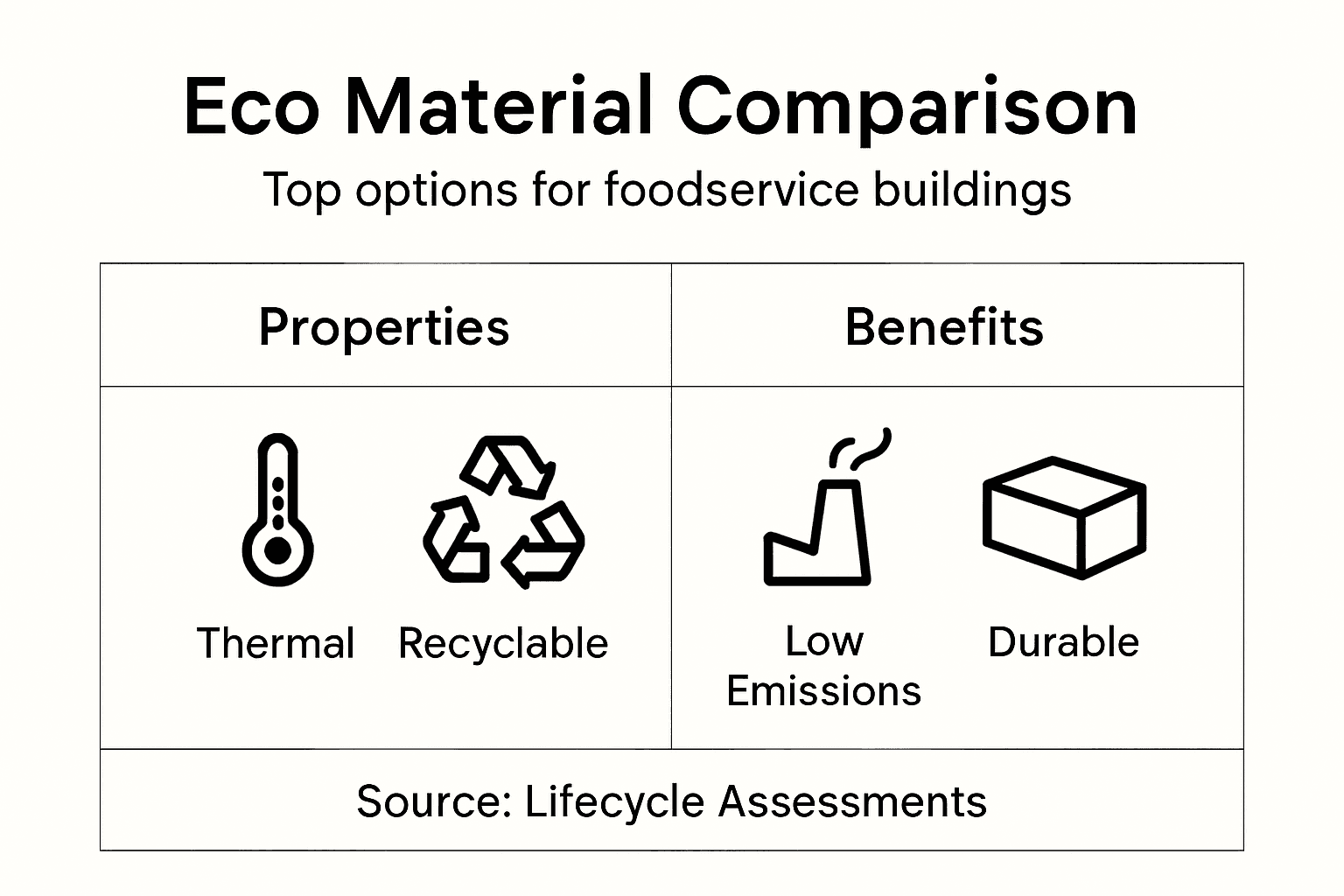
Here’s a side-by-side look at how popular sustainable building materials differ in their ecological and technical profiles:
| Material | Ecological Strength | Technical Advantage | Common Applications |
|---|---|---|---|
| Bamboo | Rapid renewability | High strength-to-weight | Flooring, panels, framing |
| Recycled Steel | Use of waste metals | Maintains structural integrity | Beams, supports, roofing |
| Bio-based Insulation | Natural resource use | Superior thermal regulation | Walls, roofing, green construction |
| Engineered Wood | Maximizes timber yields | Enhanced durability | Floors, beams, wall panels |
| Sustainable Concrete | Low carbon production | Strong compressive strength | Foundations, slabs, infrastructure |
Selecting sustainable materials is not just an ecological choice, but a strategic investment in building performance and environmental stewardship.
Technical considerations remain critical when evaluating these materials. Architects must assess factors like thermal efficiency, recyclability, initial costs, and long-term durability to make informed selections that align with project requirements and sustainability goals.
Pro tip: Always conduct a comprehensive lifecycle assessment when selecting eco-friendly building materials to understand their true environmental and economic implications.
Evaluating Durability And Biodegradability
Durability and biodegradability represent critical intersections in sustainable material selection, particularly for industries seeking environmentally responsible solutions. Mechanistic durability approaches have revolutionized our understanding of material performance, revealing complex interactions between environmental conditions and material longevity.
Key factors in evaluating material sustainability include:
- Chemical resistance to environmental degradation
- Thermal stability across different climate conditions
- Structural integrity over extended usage periods
- Biodegradation rate and ecological impact
- Recyclability potential after primary use
The complexity of sustainable material assessment goes beyond simple performance metrics. Sustainable material durability research demonstrates that long-term environmental impact is as crucial as immediate functional characteristics. Architects and designers must consider not just how materials perform initially, but how they degrade, transform, and ultimately contribute to or minimize ecological footprints.
Sustainable materials are not just about immediate performance, but about creating a regenerative relationship with our environment.
Advanced testing methodologies now integrate comprehensive lifecycle assessments that examine thermal stress, chemical interactions, and biological decomposition rates. These evaluations help manufacturers develop materials that balance performance, durability, and environmental responsibility.

Pro tip: Request detailed third-party lifecycle assessment documentation when selecting sustainable materials to ensure comprehensive understanding of their true environmental performance.
Certification, Safety, And Supply Chain Standards
Certification and safety standards serve as critical gatekeepers in sustainable building material selection, establishing rigorous benchmarks for environmental responsibility and performance. Sustainable building certification systems have evolved dramatically, creating comprehensive frameworks that evaluate materials beyond traditional performance metrics.
Key certification and safety considerations include:
- Global standardization across international regulatory bodies
- Environmental impact assessments
- Lifecycle performance tracking
- Supply chain transparency requirements
- Material safety compliance protocols
The complexity of modern certification extends far beyond simple compliance checkboxes. International material standards now integrate sophisticated assessment tools that examine materials through multiple critical lenses, including environmental sustainability, structural integrity, and long-term ecological impact.
Safety standards are not just bureaucratic requirements, but strategic tools for ensuring sustainable innovation.
Advanced certification processes now leverage technologies like Building Information Modeling (BIM) and comprehensive lifecycle assessments to provide unprecedented insights into material performance. These methodologies allow manufacturers and designers to make more informed decisions that balance environmental responsibility with functional requirements.
The following table highlights how certification and safety standards contribute to reliable material selection:
| Certification Factor | Business Impact | Example Standard |
|---|---|---|
| Environmental assessment | Mitigates risk, improves trust | LEED, BREEAM |
| Supply chain transparency | Supports ESG reporting | ISO 20400 |
| Lifecycle performance | Ensures long-term value | Environmental Product Declaration |
| Material safety compliance | Protects worker health | ASTM, OSHA |
Pro tip: Prioritize materials with transparent, third-party certifications that provide comprehensive documentation of their environmental and safety credentials.
Why Foodservice Industry Choices Matter
The foodservice industry stands at a critical juncture where sustainability is no longer optional but a fundamental business imperative. Sustainability practices in foodservice have transformed from niche considerations to mainstream strategic decisions that directly impact operational efficiency, environmental responsibility, and economic performance.
Key strategic implications of sustainable choices include:
- Reduced carbon footprint
- Enhanced brand reputation
- Cost savings through efficiency
- Regulatory compliance
- Consumer trust and loyalty
- Operational innovation
Beyond environmental considerations, sustainable choices represent a profound economic strategy. Catering industry sustainability trends reveal that organizations embracing sustainable practices gain significant competitive advantages, attracting environmentally conscious consumers and investors.
Sustainable choices in foodservice are not merely an environmental statement, but a comprehensive business transformation strategy.
The interconnected nature of modern supply chains means that each material selection carries cascading implications. Foodservice businesses now recognize that their choices extend far beyond immediate operational concerns, influencing global environmental systems, local economies, and long-term industry sustainability.
Pro tip: Conduct a comprehensive sustainability audit of your current material and supply chain choices to identify immediate opportunities for meaningful environmental impact reduction.
Elevate Your Foodservice Sustainability with Eco-Friendly Straw Solutions
The article highlights the critical challenge foodservice businesses face in selecting sustainable building materials that offer durability, biodegradability, and a reduced environmental footprint. These pain points align perfectly with the need for eco-conscious alternatives that support long-term environmental stewardship and operational innovation. Key concepts like lifecycle assessment, biodegradability, and supply chain transparency resonate deeply with TheOceanStraw.com’s mission to provide innovative, reusable drinking straws made from wood and plant-based materials designed specifically for the foodservice and hospitality industry.
Switching to sustainable straw products can reduce your carbon footprint, enhance brand reputation, and deliver tangible cost savings. At TheOceanStraw.com, we support your environmental goals by offering durable, safe, and biodegradable straw options that align with the most rigorous sustainability certifications. Our products empower you to meet evolving regulatory requirements while appealing to eco-conscious consumers and investors committed to sustainability and responsible sourcing.
Are you ready to take your foodservice business to the next level with truly sustainable material choices

Discover the benefits of partnering with us at TheOceanStraw.com where innovation meets environmental responsibility. Explore our product specifications and wholesale options and start transforming your sustainability initiatives today.
Learn more about how sustainable materials impact foodservice at Most Sustainable Building Material: Impact on Foodservice.
Frequently Asked Questions
What are sustainable building materials?
Sustainable building materials minimize ecological impact while maximizing performance and durability throughout their lifecycle.
How do sustainable materials impact a foodservice operation?
Sustainable materials in foodservice can reduce carbon footprints, enhance brand reputation, and lead to cost savings through greater efficiency.
What qualities should I look for in eco-friendly building materials?
When selecting eco-friendly materials, consider factors such as lifecycle assessments, recyclability, thermal efficiency, and structural integrity.
Why is lifecycle assessment important for sustainable building materials?
Lifecycle assessment provides a comprehensive evaluation of a material’s environmental impact, from production through use and disposal, ensuring informed choices for sustainability.
Recommended
- Sustainable Building Materials: Choices That Shape Eco-Friendly Spaces – The Ocean Straw
- What Sustainable Materials Mean for Foodservice Brands – The Ocean Straw
- What Makes a Material Sustainable: Key Factors for Foodservice – The Ocean Straw
- Complete Guide to Eco-Friendly Material Options – The Ocean Straw
- Restaurante saludable: qué significa en Barcelona