
Conservation and Wildlife Management – Impact on Eco Initiatives

Navigating the shift from single-use plastics can feel like an endless challenge for eco-conscious restaurant owners in North America. As local laws tighten and consumers demand greener choices, finding truly sustainable solutions becomes vital for business growth and environmental impact. This guide brings you actionable, science-backed approaches that help your restaurant align with evolving regulations, strengthen your brand’s reputation, and contribute to meaningful environmental stewardship.
Table of Contents
- Defining Conservation and Wildlife Management Today
- Major Types and Strategic Approaches Explained
- Legal Frameworks and International Agreements
- Sustainable Practices Within Hospitality Businesses
- Common Challenges and Risk Mitigation Measures
Key Takeaways
| Point | Details |
|---|---|
| Ecosystem Focus | Modern wildlife management emphasizes broader ecological health rather than just game species, integrating multiple scientific disciplines for effective conservation strategies. |
| Collaborative Strategies | Effective wildlife conservation relies on collaborative efforts among governments, NGOs, and communities to balance human development with ecosystem preservation. |
| Legal Frameworks | Comprehensive legal agreements, such as the Convention on Biological Diversity and CITES, form the foundation of global wildlife protection efforts, addressing complex conservation challenges across borders. |
| Sustainable Practices in Hospitality | Implementing environmentally conscious strategies in hospitality businesses not only supports conservation but also enhances customer engagement and profitability. |
Defining Conservation and Wildlife Management Today
Wildlife management represents a dynamic scientific discipline focused on understanding, protecting, and maintaining healthy ecological systems. Modern conservation efforts now extend far beyond traditional game species preservation, encompassing comprehensive strategies that balance ecosystem health, biodiversity protection, and human interaction.
Traditionally, wildlife management concentrated on game species and hunting regulations. Today, the field has dramatically transformed, integrating multidisciplinary scientific approaches to understand population dynamics and habitat interactions. Contemporary wildlife management now includes:
- Protecting rare and threatened species
- Restoring degraded habitats
- Monitoring population vital rates
- Developing legal and regulatory frameworks
- Implementing adaptive resource management strategies
The core objectives of modern wildlife management have expanded to include complex ecological considerations. Structured decision-making approaches now incorporate sophisticated modeling techniques that predict habitat responses and population dynamics. These scientific methods allow researchers to create more nuanced conservation strategies that consider intricate relationships between species, environments, and human activities.
Key scientific techniques in contemporary wildlife management involve integrating spatial and temporal data to understand ecosystem interactions. Researchers use advanced computational models to predict potential ecological changes, helping policymakers and conservation professionals make informed decisions about habitat preservation and species protection.
Pro tip: Develop a holistic understanding of ecosystem interactions by studying multiple scientific disciplines, including ecology, biology, and environmental science.
Major Types and Strategic Approaches Explained
Wildlife conservation integrates multiple strategic approaches designed to protect and manage ecological systems effectively. These comprehensive strategies represent a holistic framework that addresses complex environmental challenges through interconnected methodological interventions.
The primary strategic approaches in wildlife management include comprehensive conservation methodologies encompassing several critical dimensions:
- Habitat conservation and restoration
- Sustainable land-use practices
- Research and monitoring programs
- Public education initiatives
- Protected area establishment
- Waste management strategies
- Reforestation efforts
Collaborative management strategies require coordinated actions involving multiple stakeholders, including governments, non-governmental organizations, local communities, and scientific institutions. These integrated approaches aim to balance human development needs with ecosystem preservation, recognizing the intricate relationships between human activities and wildlife habitats.
Modern wildlife conservation emphasizes adaptive management techniques that respond dynamically to emerging environmental challenges. This approach involves continuous monitoring, data collection, and strategic adjustments to conservation protocols, ensuring that management strategies remain responsive to changing ecological conditions and emerging scientific insights.

Pro tip: Develop interdisciplinary collaboration skills to effectively implement comprehensive wildlife conservation strategies across different organizational and ecological contexts.
Legal Frameworks and International Agreements
Wildlife conservation law has dramatically transformed from early 20th-century regulations focused primarily on game species to comprehensive global protection mechanisms. Legal frameworks for wildlife protection now represent complex, interconnected systems designed to address multifaceted environmental challenges across national and international boundaries.
Key international agreements that form the backbone of global wildlife conservation include:
- Convention on Biological Diversity (CBD)
- Convention on International Trade in Endangered Species (CITES)
- Ramsar Convention on Wetlands
- Endangered Species Act
- International Whaling Commission Regulations
- Migratory Bird Treaty Act
- United Nations Biodiversity Conventions
Global biodiversity policy frameworks establish comprehensive targets and mechanisms for habitat protection, species conservation, and sustainable resource management. These agreements not only define conservation objectives but also create robust reporting and compliance systems that enable systematic tracking of environmental protection efforts worldwide.
Here’s a summary of key international wildlife conservation agreements and their main objectives:
| Agreement | Main Objective | Geographic Scope |
|---|---|---|
| Convention on Biological Diversity | Protect global biodiversity | Worldwide |
| CITES | Regulate endangered species trade | International |
| Ramsar Convention on Wetlands | Preserve vital wetlands habitats | Global |
| Endangered Species Act | Safeguard threatened wildlife | United States |
| International Whaling Commission | Manage whale populations | Global |
| Migratory Bird Treaty Act | Conserve migratory bird species | North America |
| UN Biodiversity Conventions | Promote sustainability and protection | Worldwide |
Modern legal frameworks recognize the intricate interdependence of global ecosystems, moving beyond traditional national boundaries to create collaborative international strategies. These comprehensive approaches include detailed mechanisms for monitoring wildlife populations, regulating international trade, establishing protected habitats, and implementing scientific research protocols that support conservation objectives.
Pro tip: Develop expertise in international environmental law to effectively navigate and contribute to global wildlife conservation efforts.
Sustainable Practices Within Hospitality Businesses
Sustainable hospitality represents a critical evolution in business strategy, transforming traditional operational models into environmentally conscious and socially responsible frameworks. Sustainability in hospitality has emerged as a fundamental approach to reducing ecological impact while simultaneously enhancing business resilience and customer engagement.
Key sustainable practices for hospitality businesses include:
- Energy efficiency through smart technology
- Comprehensive waste reduction programs
- Water conservation strategies
- Local and sustainable product sourcing
- Renewable energy integration
- Eco-friendly guest experience design
- Transparent sustainability reporting
Green hospitality practices enable businesses to minimize their environmental footprint while creating compelling value propositions for environmentally conscious travelers. These strategies encompass technological innovations, operational redesigns, and strategic partnerships that support ecological stewardship and economic sustainability.
Modern hospitality businesses recognize that sustainability is not just an environmental imperative but a competitive advantage. By implementing comprehensive ecological management strategies, organizations can reduce operational costs, attract environmentally aware customers, and contribute meaningfully to global conservation efforts while maintaining profitability and operational excellence.
Pro tip: Develop a comprehensive sustainability roadmap that integrates ecological considerations into every aspect of business operations and strategic planning.
Common Challenges and Risk Mitigation Measures
Environmental conservation faces complex challenges that demand sophisticated, multifaceted risk management strategies. Major conservation challenges require comprehensive approaches that address interconnected ecological and socio-economic dynamics.
Primary challenges in wildlife conservation and management include:
- Habitat loss and fragmentation
- Climate change impacts
- Illegal wildlife trade
- Invasive species proliferation
- Human-wildlife conflict
- Pollution and environmental degradation
- Limited funding and resources
Effective risk management strategies involve structured frameworks that systematically identify, assess, and mitigate potential threats. These approaches require collaborative efforts across multiple stakeholder groups, integrating scientific research, community engagement, and adaptive management techniques to develop resilient conservation solutions.
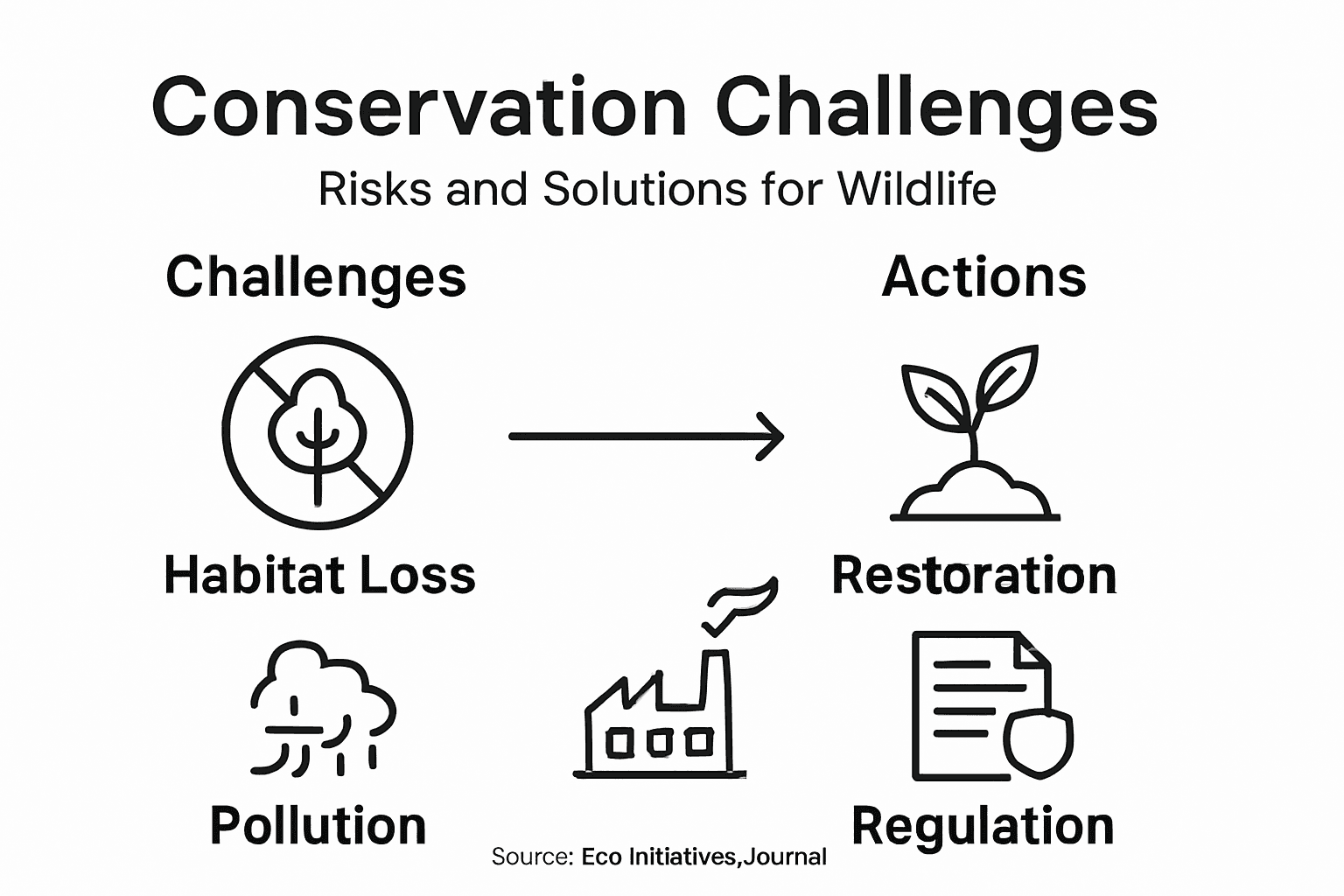
This table compares major conservation challenges with common mitigation measures:
| Conservation Challenge | Typical Mitigation Measure | Impact on Ecosystems |
|---|---|---|
| Habitat loss | Restoration and land-use planning | Improves biodiversity |
| Climate change | Climate adaptation strategies | Strengthens species survival |
| Illegal trade | Enforcement and monitoring | Reduces species depletion |
| Invasive species | Targeted removal and prevention | Protects native habitats |
| Pollution | Comprehensive cleanup initiatives | Restores environmental health |
Successful risk mitigation demands a proactive and dynamic approach that anticipates potential challenges and develops flexible response mechanisms. By implementing comprehensive monitoring systems, leveraging technological innovations, and fostering interdisciplinary collaborations, conservation organizations can more effectively address emerging environmental threats and protect critical ecosystems.
Pro tip: Develop a comprehensive risk assessment framework that incorporates continuous monitoring, stakeholder feedback, and adaptive management principles.
Enhance Your Eco Initiatives With Sustainable Solutions
The challenges highlighted in “Conservation and Wildlife Management – Impact on Eco Initiatives” emphasize the urgent need for businesses to adopt sustainable practices that reduce environmental harm and support wildlife conservation efforts. Key issues such as habitat degradation and pollution demand eco-friendly alternatives, especially in sectors like hospitality where waste generation is high. By choosing reusable and biodegradable products, companies can directly contribute to reducing plastic pollution, which threatens countless species and ecosystems.
At TheOceanStraw.com, we provide innovative wooden and plant-based reusable straws that align perfectly with the goals of sustainable hospitality and wildlife conservation. Our durable and biodegradable straws offer a practical way to reduce single-use plastic waste while enhancing your business’s environmental footprint. Explore our detailed product information and discover how integrating eco-conscious solutions supports adaptive resource management and habitat conservation strategies discussed in the article.
Take a decisive step towards safeguarding biodiversity and strengthening your sustainability roadmap. Visit TheOceanStraw.com today to request samples, learn about wholesale options, and become part of the movement transforming hospitality through eco-friendly innovation.
Frequently Asked Questions
What is the primary focus of modern wildlife management?
Modern wildlife management focuses on understanding, protecting, and maintaining healthy ecological systems, encompassing strategies that include protecting rare species, habitat restoration, monitoring populations, and balancing ecosystem health with human interaction.
How do legal frameworks support wildlife conservation?
Legal frameworks for wildlife conservation establish international agreements that regulate species trade, habitat protection, and biodiversity preservation. They provide structured mechanisms for compliance and monitoring to effectively safeguard ecosystems.
What are some key strategies used in wildlife conservation?
Key strategies in wildlife conservation include habitat conservation and restoration, sustainable land-use practices, public education initiatives, and the establishment of protected areas to promote long-term ecological health.
What challenges does environmental conservation currently face?
Environmental conservation faces challenges such as habitat loss, climate change impacts, illegal wildlife trade, invasive species, human-wildlife conflict, pollution, and limited funding. Addressing these challenges requires comprehensive risk management strategies and collaboration among stakeholders.
Recommended
- Wildlife Conservation Management: Complete Guide – The Ocean Straw
- 7 Key Lessons for Eco-Friendly Wildlife Management Class – The Ocean Straw
- Environmental and Wildlife Management: Big Impact for Food Service – The Ocean Straw
- Conservation Wildlife Management: Impact on Foodservice Sustainability – The Ocean Straw